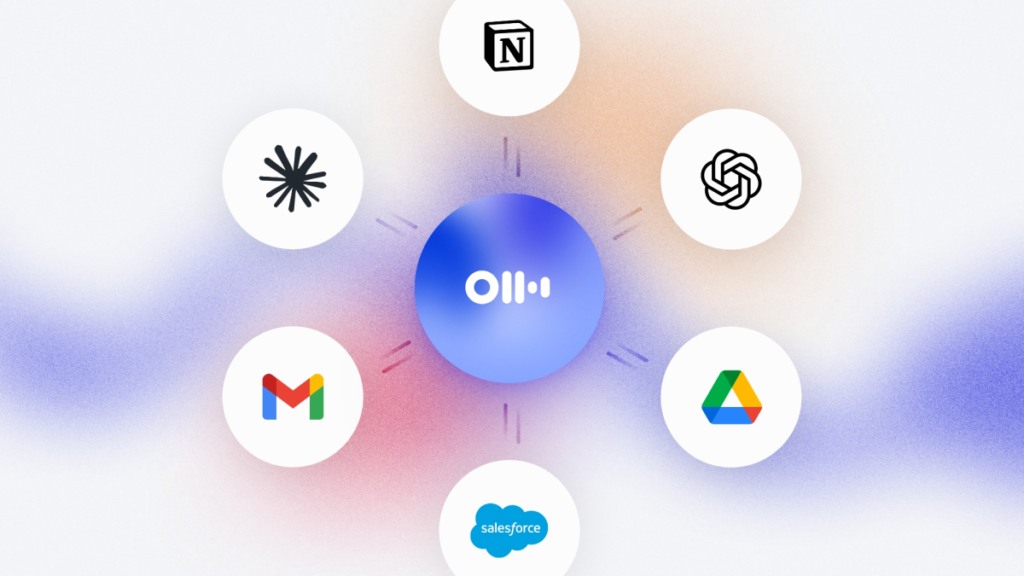

Otter has been the go-to AI note-taker for meetings for a while now, but the company is making a move that shifts it from a passive recorder to something more like an enterprise search tool. Starting today, you can connect your Gmail, Google Drive, Notion, Jira, and Salesforce accounts to Otter and query that data alongside your meeting transcripts.
That’s a pretty significant expansion of scope. Instead of just answering “what did we decide in that call last Tuesday?”, you can now ask things like “show me the email thread about the Q3 budget, the related Jira tickets, and the meeting where we discussed it.” The idea is to turn Otter into a single pane of glass for all the stuff that usually gets scattered across a dozen different apps.
The integrations themselves are fairly straightforward. You authenticate each service through Otter’s interface, and the AI indexes the data. The search uses the same natural language interface that Otter already has for meeting transcripts, so the learning curve is minimal. If you’ve used Otter’s meeting search before, this will feel familiar.
What’s interesting is what Otter chose to support first. Gmail and Google Drive are obvious — they’re ubiquitous. Notion and Jira are popular with the same knowledge-worker crowd that uses Otter. Salesforce is a bit of a curveball, but it makes sense if you think about sales teams who live in both meetings and CRM data. The company says Microsoft Outlook, Teams, SharePoint, and Slack are coming soon, which covers the other major enterprise ecosystem.
I’ve been testing this for a few days, and the results are better than I expected. The AI does a decent job of understanding cross-app context. For example, I asked “what’s the status of the onboarding project?” and it pulled a Notion doc, a Jira ticket, and a meeting transcript from last week, then summarized the relationship between them. It’s not perfect — sometimes it misses things or pulls irrelevant results — but it’s impressive for a v1.
There are some limitations worth noting. The search only covers data from the point you connect each service, so historical data before integration won’t show up unless you manually sync it. Also, the AI’s ability to connect dots across apps depends heavily on how well your team tags and organizes data. If your Jira tickets are a mess and your Notion docs are unstructured, don’t expect magic.
Privacy-wise, Otter says the connected data is encrypted and only accessible to the user who authenticated it. Enterprise admins can set policies around which integrations are allowed. That’s fine for small teams, but larger organizations will probably want more granular controls before rolling this out broadly.
The bigger question is whether people actually want yet another search interface. We’ve seen this play before — Google tried with Google One, Microsoft with Copilot, and a dozen startups with universal search tools. Most of them failed because they couldn’t beat the native search of each app, or because users didn’t trust them with all their data. Otter has an advantage here: it already has a loyal user base that trusts it with meeting data. Adding more data types is a natural extension rather than a leap.
Still, I’m skeptical about how well this scales. The demos are clean because they use well-organized test data. Real enterprise data is messy, duplicated, and full of permissions issues. Otter’s AI is good, but it’s not magic. If this feature becomes popular, the company will need to invest heavily in indexing speed, query accuracy, and handling edge cases.
Otter is also positioning this as a productivity play, which feels right. The pitch is “stop switching between apps to find what you need.” That resonates with anyone who spends their day alt-tabbing between Gmail, Slack, and Jira. If Otter can deliver on that promise consistently, it becomes a sticky product that’s hard to leave.
Microsoft and Google are watching, obviously. Both have their own AI search tools that integrate with their ecosystems. But Otter’s advantage is being platform-agnostic — it works across both Google and Microsoft tools, plus the third-party apps that neither of them owns. That’s a rare position.
For now, this is a solid update that makes Otter more useful beyond the meeting room. The integrations are well-chosen, the search works reasonably well, and the direction is smart. I’d like to see better historical indexing and more granular permissions before I’d recommend it to a large enterprise, but for teams that already use Otter, this is a no-brainer feature to turn on.
Otter is betting that the future of work tools is about connection, not isolation. That’s a bet worth making.
Comments (0)
Login Log in to comment.
Be the first to comment!