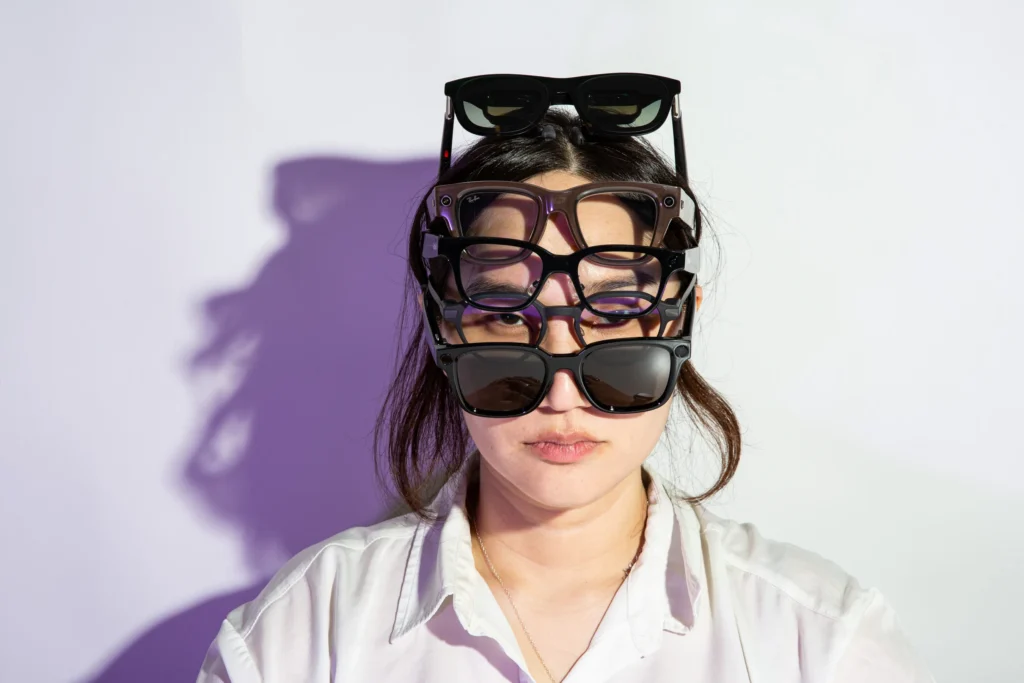

I’m currently wearing the Even Realities G2. Two pairs of Rokid glasses are sitting on my desk. The Meta Ray-Ban Display is charging next to its Neural Wristband. In my closet, there are six pairs of cheap smart sunnies that some overenthusiastic Walmart rep sent me, stacked next to Xreal, RayNeo, Lucyd, and an old pair of Razer Anzu. Later today, I’m calling my optician to see if the new Ray-Ban Meta Optics can actually handle my prescription.
I have one face. I am drowning in smart eyewear.
And the problem isn’t the hardware anymore. The G2s feel light enough to forget you’re wearing them. The Rokids have decent displays. The Meta glasses finally look like normal glasses instead of something out of a sci-fi reject bin. The tech has gotten smaller, lighter, and more comfortable. That part is genuinely impressive.
But every single one of these things suffers from the same core issue: there’s nothing compelling to do with them.
Notifications on your face? Great, now I can be interrupted while looking at someone. Turn-by-turn directions? My phone already does that, and I don’t have to charge it every three hours. Take photos hands-free? I’ve done that maybe twice. The killer app everyone keeps promising just isn’t here.
I’ve been testing these things for years now. Every new pair arrives with the same pitch: “This is the one that changes everything.” And every time, I end up with a drawer full of glasses that do a little bit of everything and nothing particularly well.
The Meta Ray-Ban Display has the best ecosystem integration, but the battery life is a joke. The Rokid glasses have a crisp display, but the field of view is still too narrow. The Even Realities G2 is the most comfortable pair I’ve worn, but the software feels like it’s still in beta. None of them solve the fundamental question: why should I wear these instead of just pulling out my phone?
The Neural Wristband is interesting in theory. Gesture control could be the input method that makes smart glasses actually useful. But in practice, it’s finicky. I have to think about the gestures instead of just doing them. That’s the opposite of natural.
I’m not saying smart glasses are doomed. The hardware progress is real. But we’re stuck in a loop where companies keep iterating on the form factor while ignoring the software experience. It’s like building a faster horse instead of a car.
What I want is a single, well-executed use case that makes me forget I’m wearing a computer on my face. Maybe it’s real-time translation that actually works. Maybe it’s a heads-up display for work that doesn’t feel like a gimmick. Maybe it’s something nobody has thought of yet.
Until then, I’ll keep testing. I’ll keep charging these things. I’ll keep wearing them around the house and feeling like a cyborg with nothing to do.
The glasses are ready. The software isn’t. And that’s the part nobody wants to admit.
Comments (0)
Login Log in to comment.
Be the first to comment!