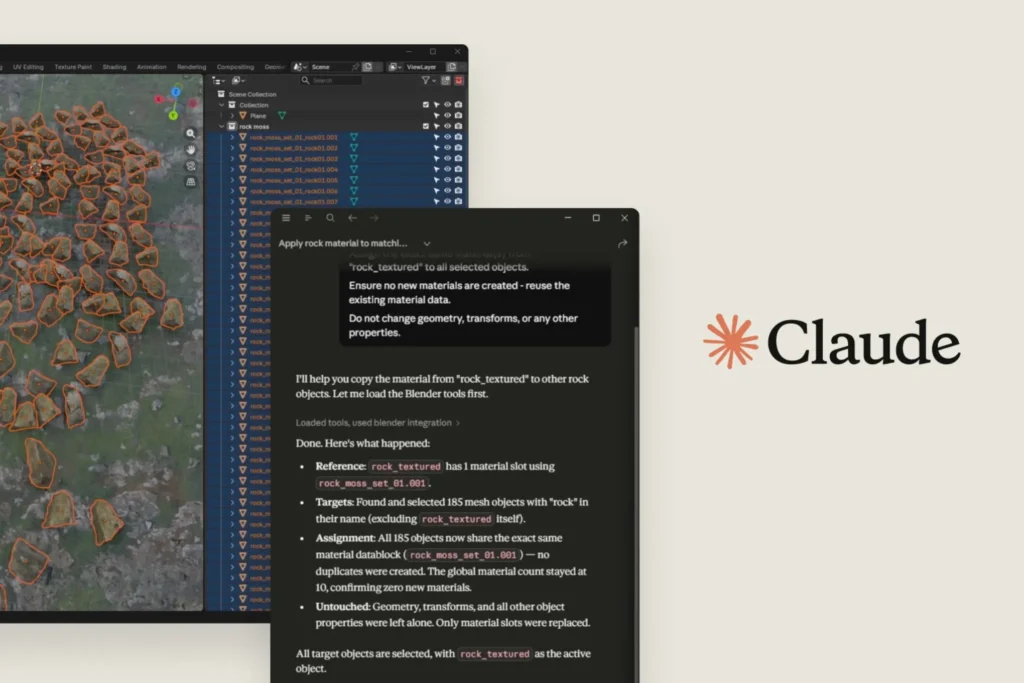

Anthropic just did something that actually makes Claude useful for people who make things for a living. They launched a set of connectors that let the AI reach directly into creative software — Photoshop, Blender, Ableton Live, Affinity, Autodesk, and a bunch of others.
This isn’t another “Claude can read your files” trick. These connectors let Claude do stuff inside each app. Change a blend mode in Photoshop. Batch-rename objects in Blender. Adjust a compressor threshold in Ableton. All from the chat interface, without you having to switch windows and manually follow instructions.
I’ve been burned by AI “integrations” before — most of them are just fancy wrappers around an API call that returns text you still have to paste in manually. These connectors look different. They’re reading app state, pulling data, and triggering actions. That’s the kind of integration that actually saves time.
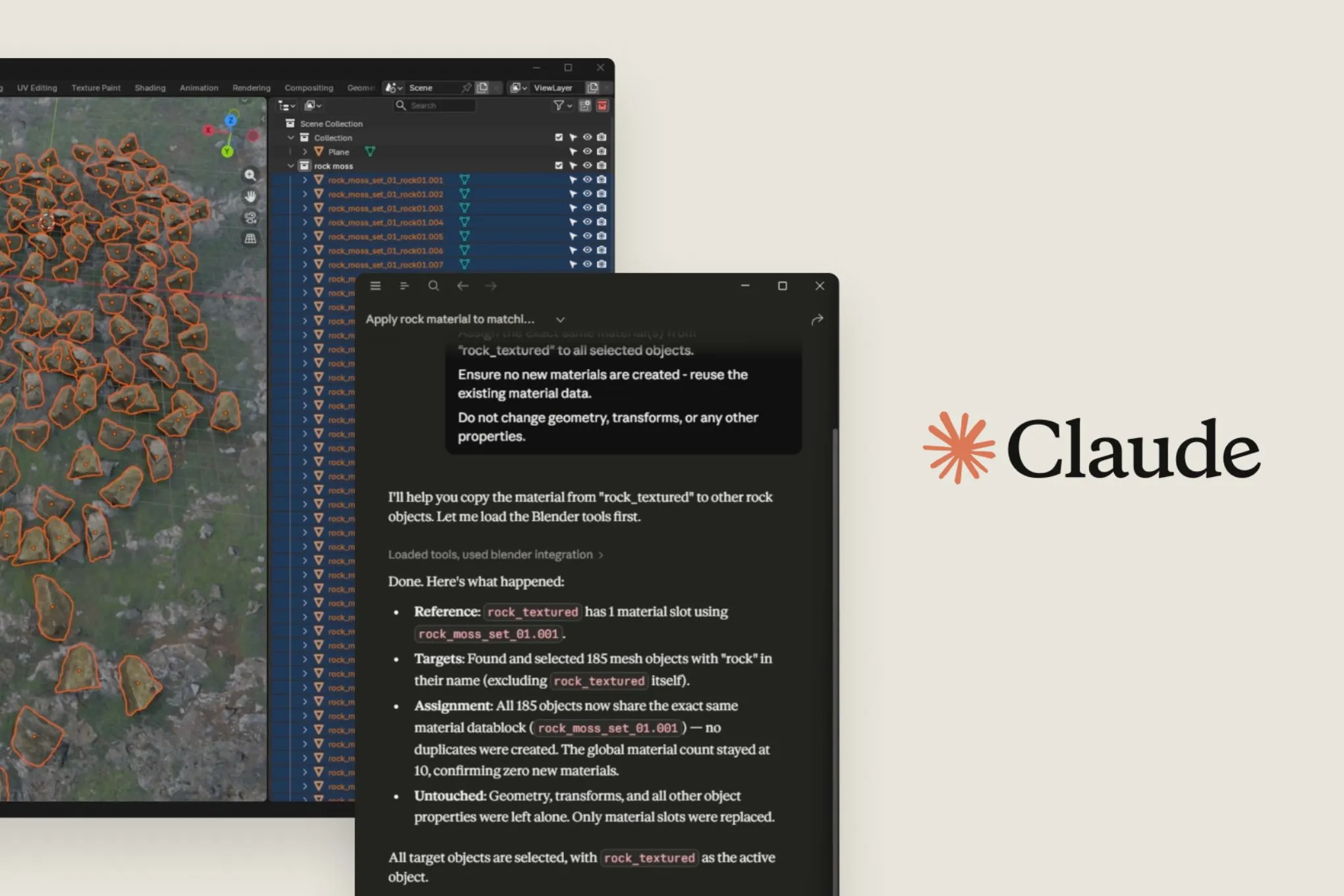
Take the Blender connector. The example Anthropic showed — debugging scenes, building new tools, batch-applying object changes — is exactly the grunt work that eats up hours. If Claude can reliably rename 50 objects following a naming convention, or apply a material to a selection set, that’s real productivity. Not the fake kind where you save 30 seconds on an email.
The Adobe Creative Cloud connector covers Photoshop, Illustrator, After Effects, and Premiere Pro. For Photoshop specifically, Claude can create layers, apply adjustments, run scripts. That’s more than I expected. I was half-expecting a glorified search function.
Ableton Live integration is interesting too. Claude can manipulate tracks, clips, effects, and automation. If you’ve ever spent 20 minutes trying to find the right reverb preset while your creative momentum evaporates, having an AI that can just do it while you keep playing feels like a genuine workflow improvement.
Autodesk support covers Maya, 3ds Max, and AutoCAD. Affinity gets Photoshop-level treatment. That’s smart — not everyone wants Adobe’s subscription model, and Affinity users are usually power users who’d actually use AI connectors.
This follows the launch of Claude Design earlier this month, which was Anthropic’s first real swing at creative tools. Design was more about generating assets and layouts. These connectors are about editing existing work. Together, they actually cover a decent spectrum of the creative workflow.
I do have some skepticism. Connectors like these live or die on reliability. If Claude misidentifies a layer or applies an effect to the wrong object, you’re spending more time fixing mistakes than you saved. Anthropic didn’t share error rates or latency benchmarks, which makes me nervous. Also, these are presumably cloud-dependent — if your internet cuts out mid-edit, you’re stuck.
Pricing matters too. Claude Pro is $20/month. If these connectors consume massive token counts per action, the bill could add up fast for heavy users. Anthropic hasn’t detailed the pricing model for connector usage beyond the standard Claude subscription.
Still, this is the most practical AI-to-creative-tool integration I’ve seen from any major AI company. OpenAI’s ChatGPT plugins never really delivered on this front. Google’s Gemini integrations are still mostly about search and docs. Anthropic is actually targeting people who use complex software for a living.
If you work in Blender or Ableton regularly, these connectors are worth testing. Just don’t hand over control of your master project file until you’ve seen how it handles edge cases. I’ll be playing with the Blender one this weekend. Expect a follow-up if it actually works without blowing up my scene.
Comments (0)
Login Log in to comment.
Be the first to comment!