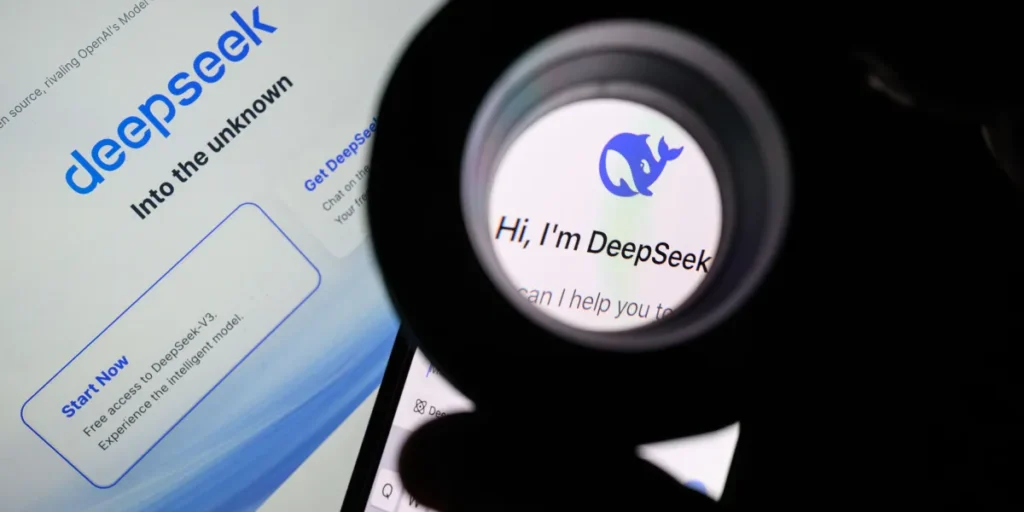

DeepSeek just released V4, and yeah, I know — another AI model drop, who cares? But this one actually matters, and not just because it’s from the Chinese lab that shook the industry last year with R1.
V4 is the first proper flagship model from DeepSeek since R1 landed in January 2025 and basically broke the AI world’s brain. That model was trained on a shoestring budget by Silicon Valley standards, yet it matched or beat much more expensive models. It turned DeepSeek from a nobody into the poster child for China’s AI ambitions overnight.
Since then, the company has been quiet. There were personnel departures, delays, and the usual geopolitical noise — US export controls, Chinese government scrutiny, all that fun stuff. So when V4 dropped on April 24, I wasn’t expecting much beyond incremental updates.
I was wrong. V4 is genuinely interesting, and here’s why.
It’s open-source and dirt cheap
DeepSeek is sticking with the open-source playbook. V4 comes in two flavors: V4-Pro, the big one for coding and complex agent tasks, and V4-Flash, a smaller, faster, cheaper version. Both are available to download, modify, and run yourself. API pricing is absurdly low — V4-Pro costs $1.74 per million input tokens and $3.48 per million output tokens. V4-Flash? $0.14 and $0.28 respectively. That’s an order of magnitude cheaper than OpenAI or Anthropic.
For developers building applications, this is huge. You get frontier-level capabilities without the vendor lock-in or the budget blowout. I’ve seen too many promising projects die because API costs spiraled. DeepSeek is basically saying “here, take this, build something, we won’t squeeze you.”
On benchmarks, V4-Pro matches Claude-Opus-4.6, GPT-5.4, and Gemini-3.1. It beats other open-source models like Qwen-3.5 and GLM-5.1 on coding, math, and STEM. DeepSeek also surveyed 85 experienced developers — over 90% put V4-Pro in their top picks for coding. That’s not just marketing fluff; that’s actual practitioner sentiment.
The memory efficiency trick is real
V4 can handle 1 million tokens in a single context window. That’s roughly three full-length novels worth of text. Most models choke past 128K or 200K tokens, either slowing to a crawl or hallucinating like crazy. DeepSeek claims they achieved this through a new architecture that doesn’t just scale up memory but actually uses it efficiently.
I haven’t tested this myself yet, but if it works as advertised, it’s a game-changer for anyone doing long-document analysis, legal work, or codebase-level reasoning. The company published a technical report alongside the release, which is refreshing — no black box nonsense.
The timing is strategic
DeepSeek could have dropped V4 quietly and let the benchmarks speak. Instead, they teased it earlier this month by adding “expert” and “flash” modes to the online version, which sparked speculation. That’s smart marketing, but it also signals confidence.
The bigger picture: China’s AI ecosystem is maturing fast. DeepSeek is no longer the scrappy underdog. They have real competition from Alibaba’s Qwen, Z.ai’s GLM, and others. But V4 reasserts their position as the open-source leader. It also puts pressure on US labs to justify their prices. If a Chinese lab can deliver this performance at these prices, what’s OpenAI’s excuse for charging 10x more?
Look, I’m not saying V4 will change the world overnight. R1 was a shock because it came from nowhere. V4 is an expected evolution. But it’s a damn good one. If you’re building AI applications and haven’t looked at DeepSeek yet, now’s the time.
Comments (0)
Login Log in to comment.
Be the first to comment!