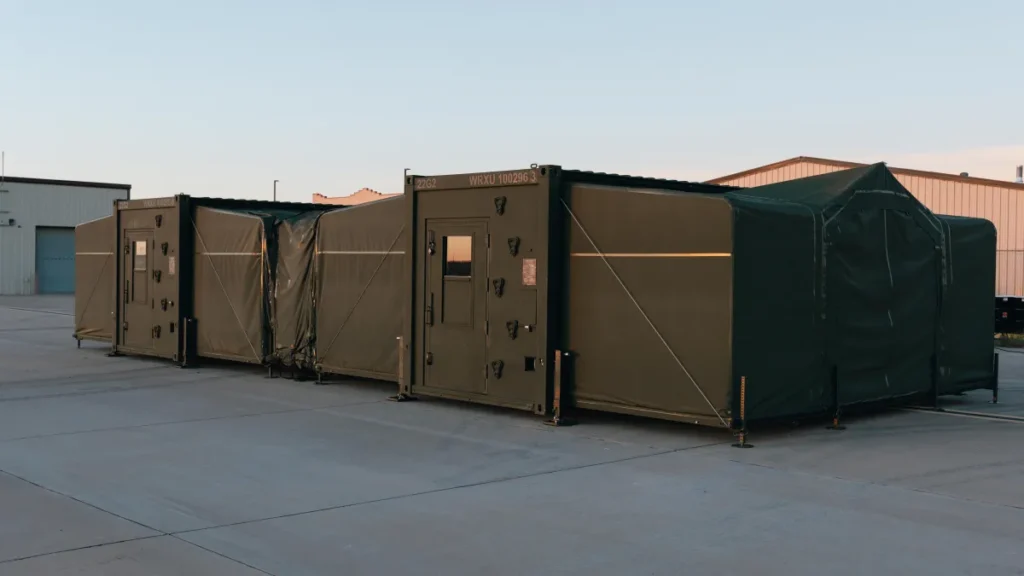

Firestorm Labs just closed an $82 million Series B to do something that sounds straight out of a sci-fi novel: pack an entire drone factory into a shipping container and ship it to the front lines.
The company calls these “micro-factories.” They’re modular, self-contained production units that can be airlifted or trucked to wherever drones are needed. The idea is to bypass the traditional supply chain entirely. Instead of building drones in a central facility and shipping them across the globe, you build them on-site, on-demand, using local materials and local labor.
This is higher than I expected for a Series B in the defense tech space, especially one focused on manufacturing rather than a flashy new platform. But the logic is sound. The war in Ukraine has shown that drone production needs to be fast, flexible, and resilient. Centralized factories are vulnerable to strikes, and shipping finished systems can take weeks. A containerized factory can be operational in days and moved just as quickly.
The containers themselves are roughly 40 feet long and equipped with 3D printers, CNC mills, and assembly stations. Firestorm claims each unit can produce a specific type of drone, like their Tempest quadcopter, at a rate of dozens per day. The system is designed to be operated by a small team with minimal training.
Now, this approach has been tried before. There have been other attempts at deployable manufacturing for military applications, but they’ve often been too complex or too expensive to scale. What’s different here is the sheer amount of capital and the focus on simplicity. Firestorm isn’t trying to build everything in a container; they’re focusing on a few key components and relying on local supply chains for the rest.
The company has already secured contracts with the U.S. Department of Defense and allied nations. They’re not just pitching a concept; they’re delivering units. The $82 million will go toward scaling production of the containers themselves and expanding their drone lineup.
I’m curious to see how this plays out in real-world conditions. Mobile manufacturing sounds great on paper, but logistics, maintenance, and quality control in a warzone are brutal. Still, if Firestorm can make this work, it could fundamentally change how militaries think about production. Instead of a single factory that’s a high-value target, you have dozens of small, distributed units that are hard to knock out.
It’s also worth noting the broader trend here. Defense tech is increasingly borrowing from the playbook of consumer tech: modularity, speed, and decentralization. Firestorm’s approach feels like the hardware equivalent of edge computing. You push the processing power where it’s needed, rather than relying on a central hub.
Whether this is the future of military manufacturing or just another well-funded experiment remains to be seen. But I’m definitely watching.
Comments (0)
Login Log in to comment.
Be the first to comment!