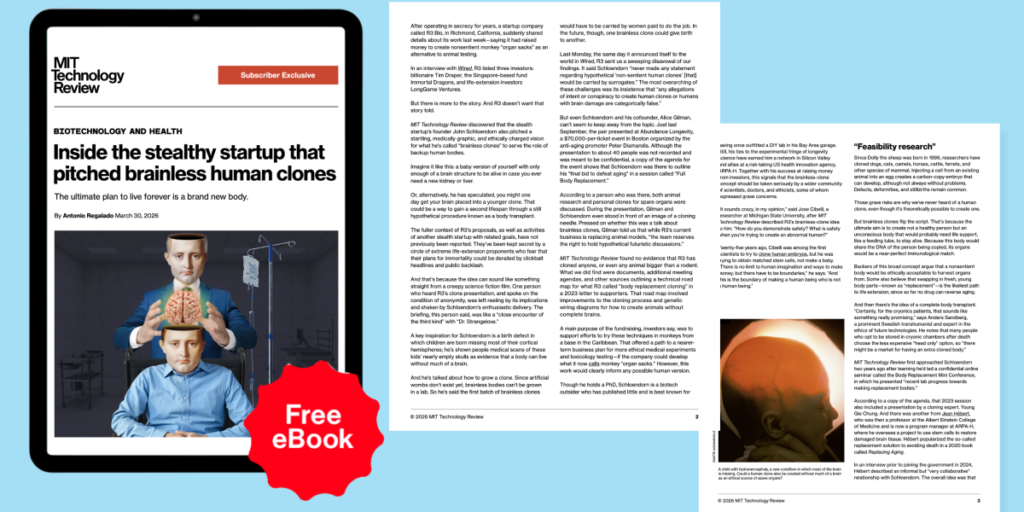

The ultimate plan to live forever is a brand new body.
That’s the pitch from R3 Bio, a small startup that’s been operating under the radar until now. They’ve proposed something that sounds like science fiction: growing human clones that lack brains, essentially empty vessels that could serve as replacement bodies. No consciousness, no personhood — just a biological shell waiting for a new occupant.
Antonio Regalado broke this story for MIT Technology Review, and honestly, it’s the kind of thing that makes you put down your coffee and stare at the wall for a minute.
Let me be clear upfront: this isn’t happening tomorrow. R3 Bio is early-stage, secretive, and the technical hurdles are staggering. But the fact that someone is seriously pursuing this — and getting funding for it — tells you something about where biotech is heading.
The core idea is deceptively simple. Take a donor cell, edit it to prevent brain development, then use cloning techniques to grow an embryo that develops into a full human body with no higher brain functions. No cortex, no consciousness, no capacity for suffering. Just a body with all the organs and tissues you’d need for a transplant — or, in the most extreme scenario, a vessel for your own consciousness.
Of course, the word “simple” is doing a lot of heavy lifting here. We’re talking about manipulating human development at the earliest stages, preventing the formation of the very thing that makes us human. The technical challenges are immense, and that’s before you get to the ethical ones.
I’ve been following this space for a while, and the brainless clone concept has been floating around in bioethics circles for years. It usually gets dismissed as too speculative or too morally fraught. But R3 Bio seems to be taking it seriously enough to put money and research behind it.
The article also links to related work: a researcher who wants to replace your brain little by little, and stem-cell therapies that actually work. It’s worth reading those too, because they paint a broader picture. We’re not just talking about one weird startup — we’re talking about a whole ecosystem of people trying to solve the problem of aging and death through radical body modification.
My take? The science is fascinating, but the ethics are a minefield. Even if you can grow a brainless human body, should you? What does it mean for how we value human life if we start manufacturing human-shaped biological products? And there’s the practical question: even if you have a perfect clone body, how do you move your consciousness into it? That’s a problem neuroscience hasn’t even begun to solve.
But I appreciate that R3 Bio is at least being somewhat transparent about what they’re doing. Stealthy doesn’t mean invisible, and this kind of research is better done in the open where it can be debated and regulated.
If you want the full details, the MIT Tech Review piece is behind a paywall, but it’s worth the subscription. This is the kind of reporting that matters — covering the bleeding edge before it becomes mainstream, and asking the hard questions before the technology gets away from us.
I’ll be watching this space closely. Whether R3 Bio succeeds or fails, the questions they’re raising aren’t going away.
Comments (0)
Login Log in to comment.
Be the first to comment!