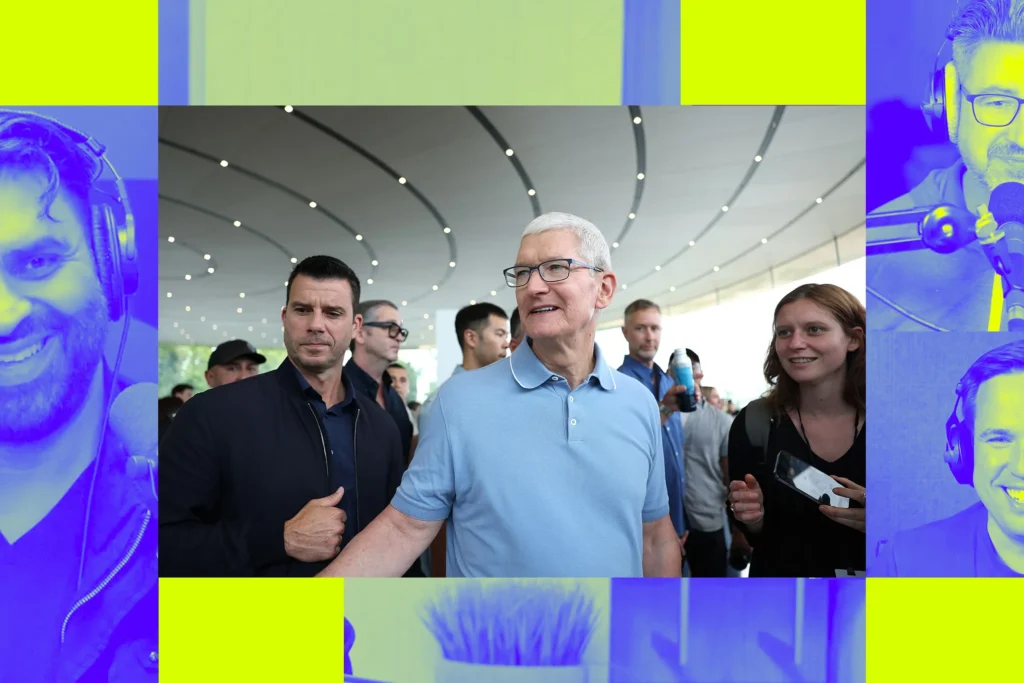

We all knew this day was coming. Tim Cook has been Apple’s CEO for over a decade, and the rumors about his successor have been swirling for at least the last year. John Ternus, Apple’s hardware engineering chief, has been the obvious pick for a while now. But when the news actually dropped this week, it still hit like a surprise — because Apple doesn’t do succession drama. They just do it, quietly, and then the world has to catch up.
The Vergecast brought in John Gruber from Daring Fireball to talk through the implications, and honestly, it’s the kind of conversation that makes you realize how much of Apple’s identity is tied to Cook’s era. Not Jobs’s shadow — Cook’s own legacy. And it’s a mixed bag.
Let’s start with the good. AirPods. That was pure Cook-era magic. Apple didn’t invent wireless earbuds, but they made them disappear into everyday life. No wires, no fuss, just a little white stem that somehow became a cultural icon. The AirPods launch was a masterclass in product execution — and it made Apple a ton of money. The chip design (the H1, later the H2) gave them an edge in latency and battery life that competitors still struggle to match. That’s Cook’s Apple at its best: iterative, ecosystem-driven, and quietly dominant.
Then there’s the Apple Watch. Cook pushed it through when Jobs supposedly hated the idea of a watch. It started as a fashion accessory with health features, but over the years, it became a legitimate medical device. The ECG, fall detection, blood oxygen monitoring — these aren’t gimmicks. They’ve saved lives. And the Watch became Apple’s most personal device, which is saying something for a company that makes the iPhone.
Now for the misses. The Touch Bar. Oh, the Touch Bar. It was a solution in search of a problem, and Apple knew it. The idea was clever — a dynamic strip of OLED that changed based on what you were doing — but in practice, it was a fingerprint magnet that removed the physical Escape key and made muscle memory useless. Developers barely supported it. Power users hated it. The Touch Bar was a dead end, and Apple quietly killed it when the MacBook Pro got redesigned. That’s the kind of product that happens when engineering runs ahead of user need.
And let’s talk about the Mac Pro. The 2019 Mac Pro was a beautiful, expensive, and absurdly powerful machine — but it was also a sign that Apple had lost touch with the pro market. The price was astronomical, the modularity was limited, and the whole thing felt like a vanity project. Meanwhile, the MacBook Air and MacBook Pro with Apple Silicon have been genuine triumphs. The M1, M2, and M3 chips redefined what a laptop could do. So Cook’s legacy on the Mac side is a strange mix: he let the pro line rot for years, then saved it with a silicon revolution that nobody saw coming.
What about services? Cook made Apple a services company. iCloud, Apple Music, Apple TV+, iMessage, the App Store — these are now massive revenue streams. But they also brought regulatory headaches. The Epic Games lawsuit, the EU’s Digital Markets Act, the constant complaints about the 30% cut. Cook’s Apple became more profitable, but also more defensive. The company that once stood for “it just works” now spends a lot of time in court arguing about what “works” means.
Then there’s the car project. Apple spent billions on a self-driving electric vehicle that never shipped. It was the worst-kept secret in tech, and it consumed talent and money for years before being quietly canceled. That’s a failure of ambition, not execution. Cook couldn’t say no to the project even when it was clear it wasn’t going anywhere. It’s a reminder that even the best CEOs can get stuck on a vision that doesn’t match reality.
Now Ternus takes over. He’s a hardware guy, which makes sense — Apple’s future is still about chips, devices, and the ecosystem that ties them together. But the challenges are different. The iPhone market is mature. Growth has to come from services, wearables, and maybe — just maybe — something like the Vision Pro. The Vision Pro is the most ambitious product Apple has shipped since the iPhone, but it’s also a niche device at a $3,500 price point. Ternus will have to decide whether to double down on spatial computing or let it fade into a footnote.
The question I keep coming back to is whether Apple can still surprise us. Cook’s Apple was reliable, profitable, and occasionally brilliant. But it wasn’t magical. The AirPods were the last product that felt like pure Apple magic. Everything since has been iterative or expensive. Ternus has a chance to bring back some of that spark, but he’s also inheriting a company that’s bigger, more regulated, and more risk-averse than ever.
I don’t envy him. But I’m curious to see what he does.
Comments (0)
Login Log in to comment.
Be the first to comment!